


How to Choose the Right Integrated Solar Street Light for Different Road Conditions?
Choosing an integrated solar street light for a road project should start with the road itself, not the advertised wattage of the lamp. Road width, pole height, spacing, traffic conditions, required illumination, local solar resources, and expected operating hours all affect the appropriate configuration. A 60W system may be suitable for one road but inadequate for another, while a higher-power model may be unnecessary if the installation height and lighting area are limited.
For project owners and contractors, the most reliable approach is to match the lighting system to actual site conditions and then determine the required LED power, solar panel capacity, battery storage, optical distribution, and mounting configuration.
What Should Be Evaluated Before Choosing an Integrated Solar Street Light?
Before comparing specific models, collect the basic information about the installation site. At minimum, a road-lighting assessment should include:
Road width and number of lanes
Required mounting height
Distance between lighting poles
Target illumination level
Expected lighting hours per night
Local sunlight availability
Seasonal rainfall and cloudy conditions
Surrounding trees, buildings, or other sources of shading
These factors determine the energy and optical requirements of the lighting system. Looking at wattage first and site conditions later often leads to either an underpowered system or unnecessary equipment costs.
Which Types of Solar Street Light Are Suitable for Different Road Conditions?
There is no single configuration that works equally well for every road. Buyers comparing different types of solar street light should consider how each configuration handles the relationship between power output, mounting height, pole spacing, energy storage, and light distribution.
| Road environment | Typical lighting requirement | Important selection factors |
|---|---|---|
| Residential and access roads | Moderate, consistent illumination | Compact power, suitable optics, reasonable pole spacing |
| Village and rural roads | Reliable overnight operation | Battery reserve, solar charging capacity, weather conditions |
| Urban roads | Uniform roadway coverage | Optical distribution, mounting height, spacing |
| Industrial roads | Higher illumination demand | Higher output, environmental protection, operating duration |
| Major roads and highways | Wide-area and safety-oriented lighting | Mounting height, optical control, system capacity, pole spacing |
The table should be viewed as a preliminary selection framework rather than a universal lighting specification. A professional project still requires site-specific calculations.
How Does Road Width Affect Solar Street Light Selection?
Road width directly affects the required light distribution. A narrow access road does not necessarily benefit from a very high-power luminaire because excessive output can create inefficient light concentration around the pole.
For wider roads, the optical system becomes increasingly important. The luminaire needs to distribute light across the roadway instead of simply producing a high amount of raw lumen output.
This is why buyers should evaluate beam angle and optical distribution together with LED power. A well-designed optical system can make more effective use of the energy produced by the solar panel and stored in the battery.
Why Does Mounting Height Matter?
Mounting height affects both coverage and light distribution. As the luminaire is installed higher, the illuminated area generally increases, but the required optical performance and system output may also change.
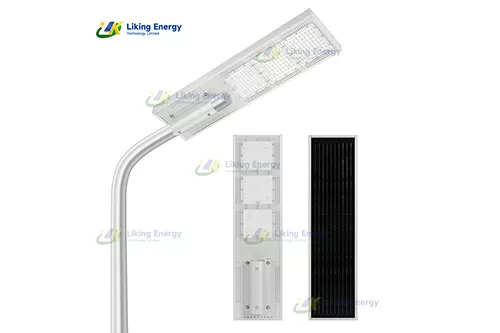
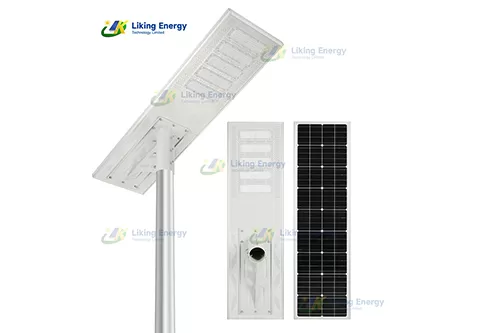
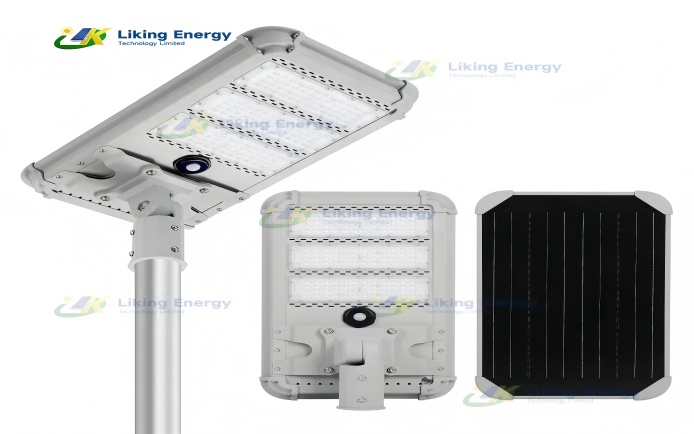
The Liking H series provides several configurations for different mounting conditions. The H40 is designed for approximately 5–7 m mounting heights, while the H150 is recommended for approximately 12–15 m. The corresponding lighting distance also increases from roughly 25–30 m for H40 to 45–50 m for H150.
This demonstrates why the correct model should be selected according to the complete installation configuration rather than simply choosing the largest available wattage.
How Should Solar Panel Capacity Be Matched to Road Lighting Demand?
The solar panel must generate enough energy during the day to replenish the energy consumed during nighttime operation. This becomes especially important when the system operates for long hours or when the installation is located in a region with seasonal cloud cover.
When evaluating a system, buyers should compare the solar panel's rated power with the expected LED load and daily operating schedule. Other factors, including solar radiation, panel orientation, shading, temperature, and system losses, also influence actual energy generation.
The Liking H series uses high-efficiency monocrystalline solar panels. Its configurations are paired with different battery capacities as system power increases, allowing the energy-generation and energy-storage components to work as part of a complete system.
How Does Battery Capacity Affect Road Lighting Reliability?
Battery capacity determines how much energy is available after sunset. This is particularly important for roads where lighting is expected to remain operational throughout the night.
A simplified calculation can illustrate the basic relationship. If a 100W LED system were to operate continuously at its rated load for 10 hours, its theoretical energy consumption would be:
100W × 10 hours = 1,000Wh
Real system design requires additional capacity because of controller losses, battery conversion efficiency, temperature effects, discharge limits, and the need for energy reserve.
Therefore, a buyer should never evaluate battery capacity independently from LED power and expected operating hours.
When Is a Higher-Power Configuration More Appropriate?
Higher-power solar street lights become more relevant when a project involves wider roads, greater pole spacing, higher mounting heights, or higher illumination requirements.
For example, the Liking H series ranges from 40W to 150W. This allows project designers to select different configurations according to road geometry and installation height rather than using one power level across every application.
When evaluating an all in one solar street light manufacturer, buyers should therefore ask for the complete configuration behind the advertised wattage. A professional manufacturer should be able to provide panel capacity, battery specifications, LED efficiency, recommended mounting height, lighting distance, and operating duration.
What Role Does LED Efficiency Play?
LED efficiency affects how much electrical energy is converted into useful light. A more efficient LED system can produce a higher lighting output without requiring a proportional increase in electrical consumption.
The Liking H series specifies LED luminous efficacy of approximately 220–230 lm/W and uses Philips or Osram 3030/5050 LED components. The product also provides adjustable beam-angle options, allowing the light distribution to be better aligned with roadway requirements.
For project buyers, however, LED efficiency should not be considered in isolation. The final lighting result depends on the combination of LED efficiency, optics, mounting height, road geometry, and pole spacing.
How Important Is Local Solar Availability?
Solar availability can vary substantially between regions and seasons. A system that receives abundant sunlight throughout the year may require a different energy configuration from one installed in a region with long rainy or cloudy periods.
Before procurement, project teams should review local solar conditions and determine whether the proposed system provides sufficient energy reserve. This is especially important for roads where lighting cannot be interrupted easily.
The expected number of rainy or low-sunlight days should also be considered when determining battery capacity. Designing only for ideal sunny conditions can create performance problems during unfavorable weather.
What Should You Ask a Solar Street Light Supplier?
Once the road requirements have been established, the next step is to compare suppliers based on technical transparency rather than quotation price alone. When evaluating a solar street light supplier, request a complete technical specification for the proposed model.
Useful questions include:
What solar panel power is used?
What is the battery chemistry and rated capacity?
What mounting height is recommended?
What pole spacing is supported?
What is the expected lighting duration per night?
How many rainy days can the system support?
What LED efficiency and optical distribution are provided?
What IP protection rating is specified?
What certifications and warranty terms are available?
These questions help buyers determine whether the product has been engineered as a complete solar lighting system rather than marketed primarily around a high LED power rating.
How Can the Liking H Series Be Matched to Different Road Requirements?
| Model | Power | Recommended Mounting Height | Approx. Lighting Distance |
|---|---|---|---|
| H40 | 40W | 5–7 m | 25–30 m |
| H60 | 60W | 6–8 m | 30–35 m |
| H80 | 80W | 7–8 m | 30–35 m |
| H100 | 100W | 8–9 m | 35–40 m |
| H120 | 120W | 10–12 m | 40–45 m |
| H150 | 150W | 12–15 m | 45–50 m |
These model ranges provide a useful starting point for preliminary selection. Actual project performance will depend on road width, pole arrangement, required illumination, geographic conditions, and the final lighting design.
What Are the Most Common Selection Mistakes?
One common mistake is choosing a product solely according to LED wattage. Another is ignoring battery capacity when calculating nighttime operating requirements.
Other frequent problems include insufficient attention to pole spacing, excessive shading around the solar panel, failure to account for seasonal weather, and using a light distribution pattern that does not match the roadway.
Another procurement mistake is comparing quotations without comparing configurations. Two products advertised as “100W solar street lights” may have substantially different solar panel capacities, batteries, LEDs, controllers, optical systems, and expected operating performance.
Final Takeaway
Selecting the right integrated solar street light starts with understanding the road rather than the product catalog. Road width, mounting height, pole spacing, lighting requirements, solar conditions, battery reserve, and optical performance should all be evaluated together.
For project buyers, the most dependable strategy is to select a complete configuration that matches the actual site conditions. This approach can improve lighting consistency, avoid unnecessary oversizing, and provide a more predictable return on the investment in solar roadway infrastructure.